My first reflection is inspired from the HE timeline we have collectively filled in for the first Workshop at Theories, Policies and Practices (see image below).
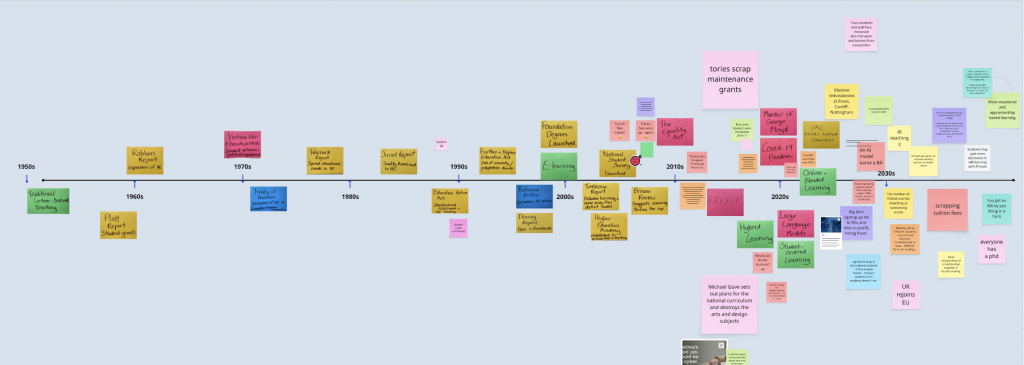
Part of the timeline include a speculative part, where we could add milestones from an imagined future. One of these speculative milestones – an hilarious one – called my attention:
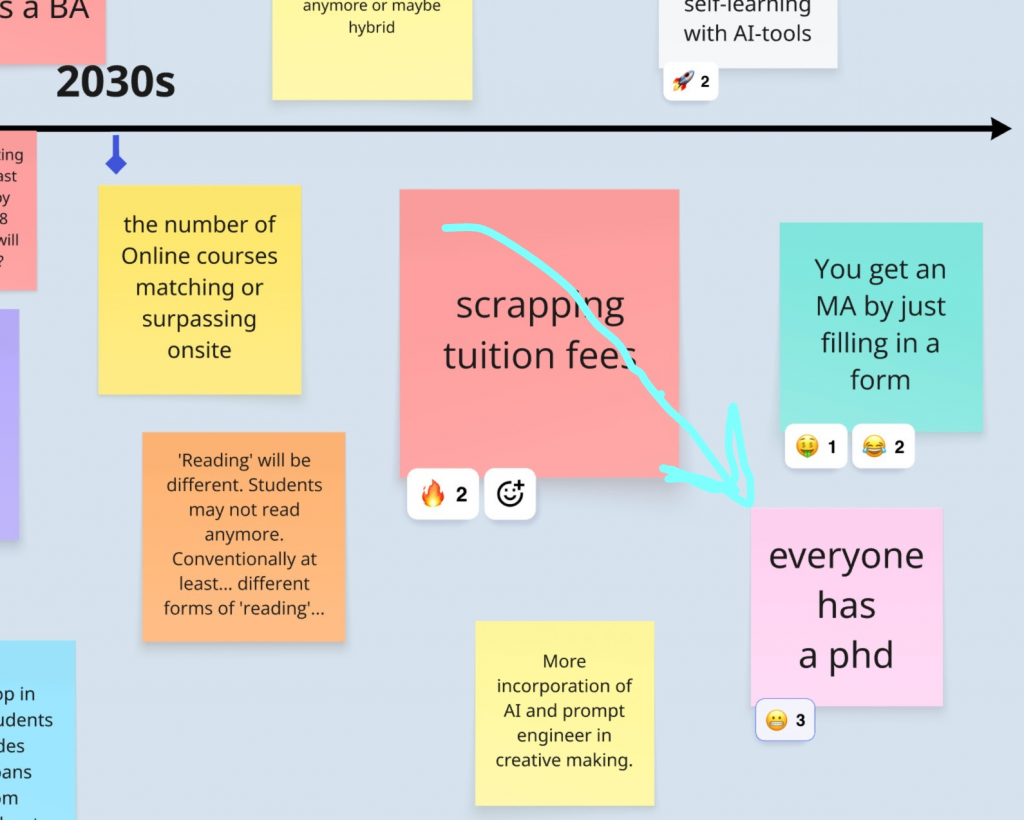
This parodic future set the seed for my story. I thought I could use a short speculative story as a reflection on crucial aspects around Higher Education, and education in general. Speculative methods have been shown to be productive strategies to imagine new alternatives and futures [1] focusing on human relationship with technology [2] but also to imagine new educational practices and contexts [3].
For this case, the idea was to set a distopic future on education where University has taken a quite abrupt change in its social role. Although pessimistic, I think this imagined future helps to warn us about where we are and where could we go. The story is an imagined conversation between myself (X1) and X2, who lives in 2050.
X1: …OK so if you are actually from the 2050, how does it look like? what do you do?
X2: I am a survivor of the educational system
X1: What does that mean?
X2: I am one of the 5% that could afford not entering University.
X1: But uni is a privilege!
X2: It was. But it became a requirement. Basically a new ID. Is the document that tells you how will you be used.
X1: Be used by whom?
X2: By the Optimiser. The Optimiser is an Agent (previously called AI) that allocates people with educational certificates to particular tasks that they define. It was long ago replaced by government.
X1: OMG. What do you do then? how are you get a job if you don’t have that certificate?
X2: it is weird. In a way I am privileged because I belong to a group of people that emerged from the landowners, we still own little pieces of land that allows us to be self sufficient. It is hard work, but it’s still a privilege. A potato is the most expensive good you can find nowadays. We can trade it for whatever we want.
X1: Tell me a bit of how education works these days. Is it true that everyone has a PhD? Because I’ve just got my PhD, and I’m so proud of it!
X2: What is a PhD?
X1: A philosophy doctor, one of the highest academic levels you can have which means you are an expert in an area.
X2: Oh no! we don’t have human experts any more! We left that to Agents.
X1: And what happened with knowledge?
X2: It’s mostly obscure to humans. At some point Agents took over the technical and the Sciences, in general.
X1: So what do humans learn when they go to university?
X2: Mostly things about the structure of University. For example, you spent most of the first year trying to understand how Muddle – the main online platform for learning – works. You have to learn a whole language to interact with it. It includes cryptography, human-machine communication, among many other skills.
X1: And then?
X2: Second year you learn how to deal with technical: how to securely access the hundreds of password protected platforms that university has. How to develop techniques to remember passwords, how to detect fraudulent humans with no credentials. You become a kind of police person that helps Muddle to “keep clean”.
X1: But how could you apply this when you finish?
X2: That is third year. Called the allocation. In here, a tutor follows you everywhere. They watch you interact with the whole University structure, detecting fraud, remembering passwords, building your portfolio, proposing initiatives. Finally, they come with a report. The report is analysed by Agents who decide where to allocate you. Most people likes jobs like password remembering, they say it helps them to keep their brain fresh. The ones with poor performances are usually allocated to what we call the “Irises”. Irises are used by Agents to explore human physiological patterns where they could hide information: digital footprints, hand marks, and of course, the iris. There’s a whole black market around these things!
References
[1] Wilkie, A., Savransky, M. and Rosengarten, M. eds., 2017. Speculative research: The lure of possible futures. Taylor & Francis.
[2] Zhu, L., Wang, J. and Li, J., 2024. Exploring the roles of artifacts in speculative futures: Perspectives in HCI. Systems, 12(6), p.194.
[3] Bayne, S. and Ross, J., 2024. Speculative futures for higher education. International Journal of Educational Technology in Higher Education, 21(1), p.39.
Leave a Reply